
Santiago Garcia Carignano, CTP
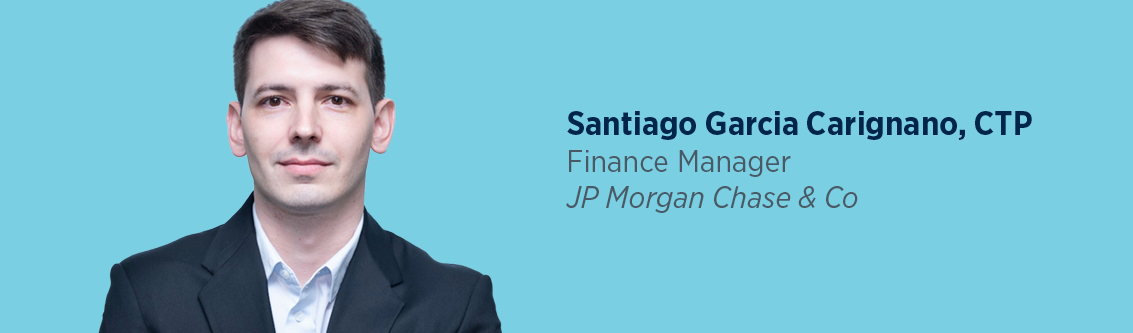
We Have a Direct Operational Impact on the Business Every Day
“Treasury combines finance, technology, operations and strategy,” said Santiago Garcia Carignano, CTP. “It’s not only about theory; it’s about putting solutions into action, implementing new developments and helping companies improve the way they manage payments, liquidity and financial processes. We have a direct operational impact on how companies function every day.”
In his six years as a financial professional, Santiago has worked in audit, intercompany accounting, treasury implementations and now finance. “Taking a non-linear path gave me a broader view of how organizations work; each role helped me understand different angles of the business,” he said.
An internship opened the door
An early-career professional, Santiago began his career as an intern with PwC. “I moved from Córdoba, a smaller city in Argentina, to Buenos Aires; that opportunity opened the door to the world of multinational corporations — everything felt new and inspiring. When companies give opportunities to people from smaller cities or different regions, it can reshape a person’s career and life.”
PwC then hired Santiago as an auditor, where he was “mainly auditing real estate investment funds and multi-strategy hedge funds.” He credits the experience with giving him a “strong foundation in financial controls, reporting and how complex organizations manage financial information.”
After PwC, Santiago joined The Walt Disney Company as part of the Intercompany Accounting team, which is when he started spending more time working on treasury-related topics. “I was involved in discussions around intercompany assets and liabilities, including which balances to maintain and which ones to collect or pay down depending on the economic environment in Latin America. It was that exposure that helped me realize how strategic treasury can be,” he said.
Next, he made the move to JPMorganChase and the role of Implementation Analyst. Here, Santiago worked as a project manager for payment implementations, including confirming client scope, supporting due diligence and documentation, coordinating account openings, and implementing a variety of payment methods from wires to ERP integrations.
Two years later, he moved into his current role of Analyst in Finance & Business Management, where his work is focused on financial analysis, budgeting, forecasting, monthly and weekly reconciliations, reporting and process automation projects.
For both roles, Santiago said the most important skills to have are organization, diligence, analytical thinking, curiosity and the ability to learn continuously. “It’s also important to know how to work with people,” he said. “No one knows everything, so having strong relationships and knowing who to reach out to when something exceeds your knowledge is very valuable.”
Two mentors who played distinct roles
“Learning from the people around you is one of the most valuable ways to grow professionally,” said Santiago. He was fortunate to have two mentors assist him in two different aspects of his career.
The first was a member of the JPMorganChase North America Sales team. Santiago describes him as “inspiring and knowledgeable,” providing career advice and exposing him to large, complex and challenging projects. Plus, it was this colleague who encouraged him to explore AFP and the Certified Treasury Professional (CTP) certification.
Once Santiago became involved with AFP, he found a second mentor who guided him regarding CTP exam strategies, career advice and practical recommendations about how to continue growing in his career.
“Both mentors helped me understand the importance of continuous learning, professional curiosity and being intentional about career development,” said Santiago.
Two critical issues in treasury today
Santiago said that at the top of his list of critical issues in treasury today is data integration and data accuracy. “We work in an environment where decisions need to be made quickly, and organizations have access to a large amount of information and many technology tools,” he said. The challenge comes from making sure those tools are properly integrated and that the information is accurate, reconciled and consistent across systems. “If different platforms show different information, it becomes harder to make confident decisions.”
As is on everyone’s mind these days, Santiago additionally named AI as a critical issue, stating it is transforming the work environment and reshaping the way treasury professionals work. “We need to keep pace with these changes, understand how new technologies can support better decision-making, and learn how to use automation and AI responsibly,” he said.
With an eye to the future
“In the future, I want to lead treasury or finance teams in their mission to help organizations improve the way they manage liquidity, risk and financial decision-making,” Santiago said. To that end, he plans to continue developing his skills in treasury leadership, AI applications in finance, data analytics, capital markets, debt structuring and strategic treasury planning.
He is particularly interested in understanding how treasury can be defined from a long-term strategic perspective, “not only as an operational function but as an area that can help organizations manage liquidity, risk, technology and growth,” he said.
It’s also important to him to gain more international experience by working with global teams and supporting organizations across different markets and regions. Having worked with multinational companies throughout his career, “I’ve found that understanding diverse business environments and perspectives is both professionally rewarding and essential in today's interconnected economy,” he said.
Looking further into the horizon, Santiago wants to give back in the same way his mentors and colleagues have assisted him: “I want to grow into leadership positions where I can contribute to strategic decisions, mentor other professionals, and help build resilient and forward-looking treasury organizations.”
The CTP helped connect his experiences and build his career
It was from a desire to build credibility and understand treasury more holistically — thereby supporting his long-term career goals — that Santiago started his journey toward earning the CTP designation.
“Balancing exam preparation with a full-time job required discipline and consistency,” he said. Santiago had to stay organized and follow his study plan, which included using the Essentials of Treasury Management book, the AFP Exam Prep Platform and bootcamp sessions/classes.
“I reviewed the material carefully and revisited the most challenging topics more than once,” he said, adding that the exam prep platform was especially useful for practicing questions and identifying the areas where he needed more review.
“Earning the credential showed me that I could balance a demanding job with a challenging certification process, and it reinforced the importance of continuous learning. I now see treasury as a strategic discipline connected to liquidity, risk, technology, operations and business decision-making,” he said.
Since gaining his CTP designation, Santiago is more confident when speaking about treasury topics. “I would recommend the CTP to early-career finance professionals, treasury practitioners, bankers supporting treasury clients and FP&A professionals who want a broader understanding of treasury and corporate finance,” he said. “It’s a great way to show your commitment to the profession and keep growing in a field that is constantly evolving.”
Join the Next CTP Info Session
SEPTEMBER 17 | 12:00 - 12:30 PM ET
Mark Grisamore, CTP, Lead Treasury Analyst
CTP Exam Deadlines
For December 1, 2026 - January 31, 2027 Window
- Early Application Deadline
September 23, 2026 - Final Application Deadline
October 28, 2026